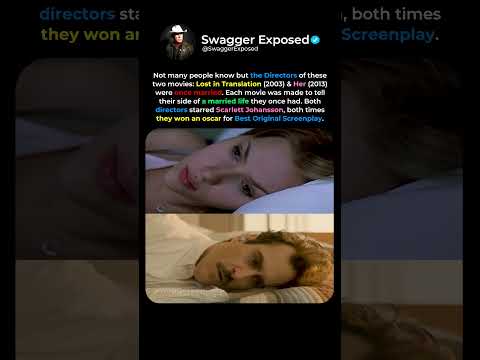
Why These Divorced Directors Made Two Movies About Each Other 🎬💔

지금 보고 있는 영상
Why These Divorced Directors Made Two Movies About Each Other 🎬💔
조회수 1,059
영상 설명 · 눌러서 펼치기
Sofia Coppola and Spike Jonze, two of the most distinctive American filmmakers of their generation, married in 1999 and divorced in 2003, a brief union that critics and audiences later came to see refracted through their art. In 2003, Coppola released Lost in Translation, a melancholic portrait of a young woman, played by Scarlett Johansson, adrift in a Tokyo hotel while her preoccupied photographer husband, widely read as a sketch of Jonze, chased his career. A decade later, in 2013, Jonze answered with Her, in which a lonely writer navigating the aftermath of divorce falls for an artificial intelligence voiced by Johansson, while Rooney Mara played an ex-wife many viewers interpreted as an echo of Coppola. Although neither director ever explicitly confirmed that the films formed a deliberate dialogue, the parallels in casting, theme, and emotional texture invited that reading. Contrary to a popular misconception, Johansson won no Academy Award for either role; instead, each film earned its director the Oscar for Best Original Screenplay, a symmetry arguably more telling, since it honored the very act of writing one's own story. Taken together, the two films stood as a rare artistic diptych, demonstrating how the private wreckage of a marriage could be transmuted into enduring cinema about loneliness, connection, and the quiet ways people grow apart.
This video is intended solely for educational and historical analysis. It does not support, promote, or glorify war or any form of hatred. Its purpose is to present verified historical facts and encourage critical understanding of past events.
This video is intended solely for educational and historical analysis. It does not support, promote, or glorify war or any form of hatred. Its purpose is to present verified historical facts and encourage critical understanding of past events.
Swagger Exposed Shorts 다른 영상

When Professor Charles Xavier Couldn't Keep A Straight Face 😂🎬
조회수 7,332

How Chris Pratt Officially Made The Marlin 1895 Into A T-Rex Rated Weapon 🦖🔫
조회수 9,218

When John Travolta Fell Asleep For Real Whilst Filming Wild Hogs 😴🏍️
조회수 30,486

When Jennifer Lawrence Tried Her Hardest To Not Laugh 😂🎬
조회수 7,367

The Star Trek Blooper Where Gates McFadden Made Patrick Stewart Scream 😂🪨
조회수 828,227

Why Snoop Dogg Showed Up As The Blue Bandana At The Super Bowl 💙🏈
조회수 244,213

When Jim Carrey Made Jennifer Aniston Break Character Twice 😂🎬
조회수 270,099

The Star Trek Blooper Where Worf Ruins The Scene 😂🚀
조회수 889,162