What a reply 🫡🔥

지금 보고 있는 영상

What a reply 🫡🔥
조회수 5,127
영상 설명 · 눌러서 펼치기
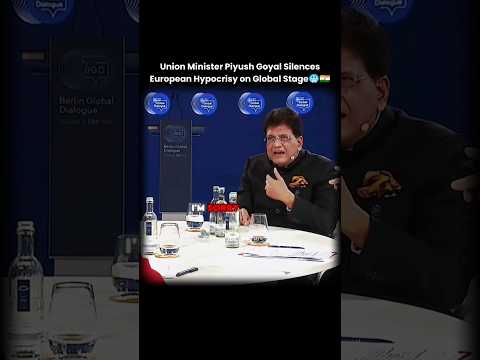
“You're giving me the perfect opening for my comments!” 🇮🇳🔥
At the Berlin Global Dialogue 2026, India's Commerce and Industry Minister Piyush Goyal challenged the fairness of Europe's climate policies during a discussion on global trade, industrial competitiveness, and the emerging geopolitical order.
The debate centred on the European Union's Carbon Border Adjustment Mechanism (CBAM), which applies a carbon cost to certain imported goods based on their embedded emissions. European industries argue that carbon pricing is necessary to tackle climate change and prevent production from shifting to countries with less stringent climate policies. But for developing economies like India, the mechanism raises serious questions about trade barriers, manufacturing costs, and whether countries that industrialised earlier are imposing additional burdens on those still developing.
During the discussion, industrial leader Emma Marcegaglia acknowledged the difficult trade-offs surrounding CBAM. Goyal seized the opportunity to challenge the underlying question: who bears responsibility for the emissions accumulated over generations of industrialisation?
He contrasted India's enormous population with its relatively small share of historical cumulative emissions, arguing that Europe's contribution to the climate problem cannot be separated from its long industrial history. When the discussion turned to cumulative emissions, Goyal's message became unmistakable: climate responsibility must account for more than today's emissions alone.
This is at the heart of the debate over climate justice, historical responsibility, and the principle of common but differentiated responsibilities. Developing countries argue that they should have room to grow, industrialise, and improve living standards without facing disproportionate costs for a crisis to which richer economies have contributed substantially over time. European policymakers, meanwhile, defend carbon border measures as a way to prevent carbon leakage and maintain comparable carbon costs for domestic and imported products.
The bigger question is not whether climate change matters—it does. The question is how the costs of tackling it should be shared, and whether climate policy can protect the environment without unfairly disadvantaging developing economies.
🇮🇳 India's argument: climate action must account for historical emissions, development needs, and fairness in global trade.
🌍 The debate: can the world achieve its climate goals without creating new economic inequalities?
🎥 Panel: “New Era, New Alliances: The Third Path?”
📍 Event: Berlin Global Dialogue 2026
🎙️ Speaker: Piyush Goyal, India's Union Minister of Commerce and Industry
🎬 Edited by: @upscpaglu
⚖️ Disclaimer: This video is edited and shared for educational, informational, commentary, and current-affairs purposes. Statements are presented in the context of a broader discussion on climate policy and international trade. The views expressed belong to the respective speakers. All rights to the original footage belong to their respective owners.
#piyushgoyal #india #bharat #news #currentaffairs #geopolitics #politics #bjp #inspiration #savage #respect #motivation #leadership #education #knowledge #upsc #upscpaglu #germany #europe #eu #summit #diplomacy #foreignpolicy #modi #gk #interview #power #facts #podcast #new
upscpaglu 다른 영상
Bro came prepared 💀🔥
조회수 18,009

What a wonderful story 🙇♂️🔥
조회수 1,460,813

Imagine India without nuclear weapons 😳🇮🇳
조회수 359,432

No words for Kalam sir 🙇♂️🔥
조회수 1,335,652
What a legend he was 🙇♂️🔥
조회수 729,669

Bro made the whole country proud 🇮🇳🔥
조회수 226,186

Well deserved reply 😂🔥
조회수 132,385

You control the rivers, we control the Strait 🗿🇮🇳
조회수 121,511